Teacher Sign in Apple
A Practical Review for Small Business Merch & Branded Patches
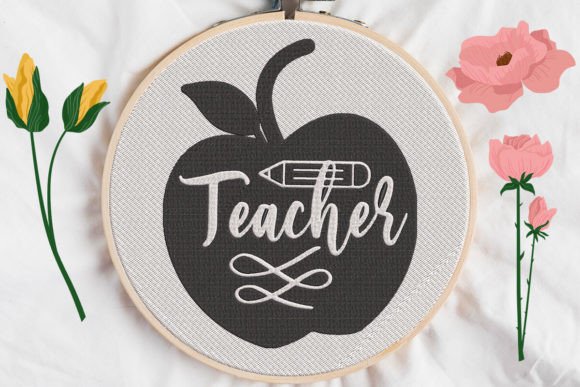
As an embroidery designer who’s digitized and stitched thousands of designs for small businesses—from neighborhood bakeries to indie florists and creative studios—I approach every new machine embroidery design with two questions: “Does it communicate brand intent clearly?” and “Will it stitch cleanly across real-world applications?” That’s why Teacher Sign in Apple caught my attention. At first glance, the title suggests warmth, recognition, and a gentle nod to education—but let’s dig deeper into how this embroidery file performs not just as decoration, but as functional brand equity.
First Impression: Friendly, Timeless, and Professionally Approachable
The name Teacher Sign in Apple immediately evokes trust, care, and quiet authority—qualities that resonate far beyond the classroom. It’s not overly cutesy or juvenile, nor is it stiff or bureaucratic. That balance makes it unusually versatile for small business merch. Think of a handmade soap studio branding their staff aprons, a local café embroidering barista caps, or a pet wellness brand adding subtle chest logos to tote bags. The design feels handmade product-adjacent without sacrificing polish—ideal for brands that value authenticity *and* professionalism.
Real-World Performance Across Business Applications
In practice, Teacher Sign in Apple shines where clarity and charm matter most: embroidered patches, custom apparel, and boutique merchandise. As a patch, it reads well at 2.5”–3.5” wide—clean lines hold up on twill, denim, and canvas. On staff uniforms (think cotton-poly blends or performance fabrics), it anchors nicely on left chests or sleeves without overwhelming. For cap embroidery, position it slightly higher than center-front to avoid distortion from the curve—and confirm the design’s topmost elements aren’t too fine to register cleanly on structured fronts.
On tote bags and aprons, Teacher Sign in Apple adds instant visual consistency. It doesn’t scream; it invites. That’s critical for customer-facing items where tone matters as much as visibility. And because it’s rooted in the School category yet broadly human-centered, it avoids niche limitations—making it unexpectedly effective for non-education brands seeking grounded, nurturing energy.
Where Caution Is Key
Like any thoughtful embroidery file, Teacher Sign in Apple has boundaries. Avoid shrinking it below 1.75” for patches—it risks losing definition in the apple stem or letter spacing. On curved surfaces like baseball caps or rounded product packaging accents, test stitch density and outline reinforcement: dense fills may pucker if the design wasn’t optimized for low-stretch substrates. Also, review thread colors carefully on dark uniforms—light green or cream apple fills can vanish without sufficient contrast or underlay stitching.
If your fabric texture is heavy (like burlap or thick linen), consider simplifying or re-digitizing minor details. Likewise, frequent-wash items—think staff aprons or reusable totes—demand tight satin stitches and secure jump threads. Always verify stabilizer choice: medium-weight cutaway works best for long-term durability, especially on knit or lightweight woven fabrics.
Brand Identity Impact: More Than Just a Logo
This isn’t just another embroidery design. When applied intentionally, Teacher Sign in Apple strengthens brand identity by signaling intentionality, warmth, and reliability. Customers subconsciously associate teacher-inspired motifs with patience, guidance, and care—traits that elevate handmade product lines, service-based studios, and community-focused shops. It also boosts buyer engagement: Etsy sellers report higher cart conversions when branded patches or apron embroidery reflect personality *and* polish.
Visually, it supports consistency across touchpoints—whether you’re using it as a cap embroidery accent, a tote bag design, or a subtle tag on product packaging. Paired with neutral typography or complementary icons, it becomes part of a cohesive system—not a standalone flourish.
Essential Embroidery Designer Notes Before Production
- Test in black and white first—to assess contrast, spacing, and visual weight without color distraction.
- Check minimum viable size—does Teacher Sign in Apple retain legibility at 2” wide? If not, request a simplified version or adjust fill density.
- Review thread color contrast on your target fabric—especially for commercial embroidery on dark or textured materials.
- Inspect letter spacing and apple outline integrity—tight kerning or thin stems may collapse at small sizes or on unstable hooping.
- Confirm hoop size compatibility—some versions may require larger hoops; cross-check before quoting clients.
- Test on real fabric, not just software simulation—stitch behavior changes dramatically with fiber content and tension.
- Use proper stabilizer—cutaway for stability, tear-away for lighter fabrics, and fusible for layered appliqué effects.
- Create a printable mockup for client approval—show scale, placement, and thread palette in context.
- Compare beside other design assets—does Teacher Sign in Apple harmonize with your existing logo, fonts, or secondary patterns?
- Confirm commercial licensing before use in small business merch—this is non-negotiable for resale, uniforms, or branded patches.
Remember: the strength of any digital embroidery file lies not in its prettiness alone, but in how reliably it translates from screen to stitch to shelf. Teacher Sign in Apple delivers on that promise—if treated with intention. It’s not just a machine embroidery design for Teacher’s Day. It’s a quietly confident asset for small business owners building something meaningful, one embroidered detail at a time.